Theme: Quantum wavefunctions
Example Project: Investigations of ultracold atom dynamics in optical lattices
Faculty Mentor: Steven Tomsovic
The experimental capabilities of exploring many-body physics have exploded for systems comprised of ultra-cold atoms [1–3]. Fundamental questions regarding how many-body systems well isolated from their environment relax, thermalize, localize, etc… are being addressed with ultra-cold gasses in optical lattices. An important theoretical model that captures essential dynamical features involving interactions and tunneling between bosons sitting in the lowest Wannier states of optical lattice sites is given by the discrete Bose-Hubbard Hamiltonian,

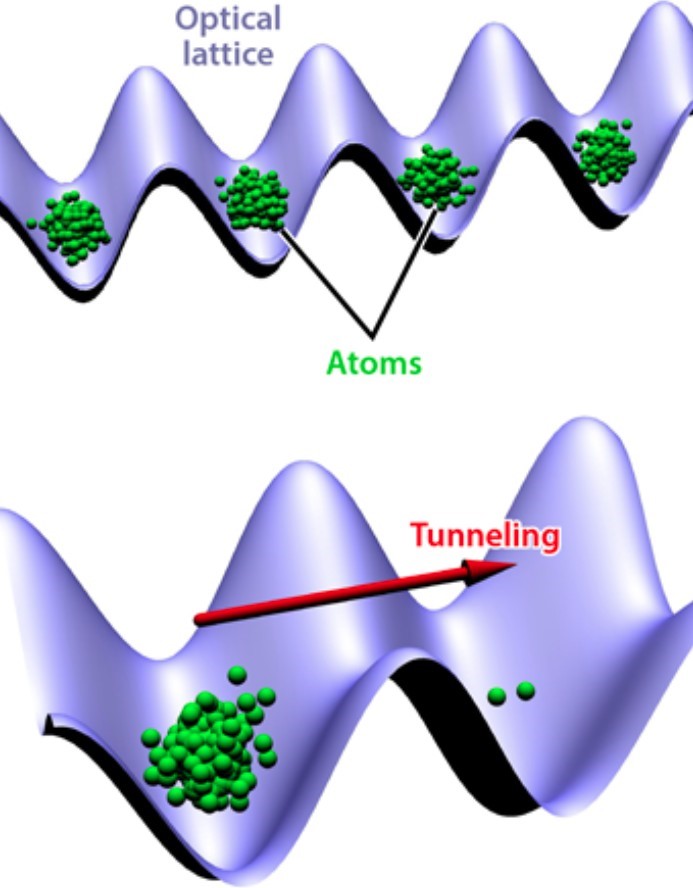
where L is the number of sites, J the tunneling or hopping energy between sites, and U the interaction strength between particles. Generalizations to two- and three-dimensional lattices are possible as well. Quantum calculations can be performed if the particle and site numbers are not too great. For larger system sizes, there is a mean field approach, the so-called truncated Wigner approximation, which allows for understanding the dynamics [4, 5]. In between these regimes is what would very appropriately be called a mesoscopic or semi-classical regime in which quantum interference phenomena between mean field solutions is still important to take into account, but direct quantum calculations are prohibitive.
Recently, Prof. Steven Tomsovic and co-workers have developed new semi-classical techniques using a coherent state approach for making semi-classical approximations to the quantum dynamics [6], and have extended the truncated Wigner approximation to include constructive quantum interference effects due to discrete symmetries [7]. An individual project would be designed for each REU student that involves exploring the quantum dynamics in such systems. The issues of relaxation, thermalization, and the role of quantum interferences would be the main focus.
Undergraduate Research
Prof. Tomsovic has been a faculty member for 25 years and has advised many undergraduate student research projects in that time. Three of his undergraduate mentees participated in a previous departmental NSF REU grant. One won a Goldwater Fellowship, and 2 went to Cornell University for graduate school. A number of his previous students have been women. Currently, he is teaching the undergraduate thesis course, and has for several years. In addition to writing their theses, the students present their research in a university-wide open poster session. The students learn how to present their work in a conference-like setting and greatly value this opportunity. Preparing for the session improves the students’ communication skills and afterward their theses are improved by their experiences presenting their work.
References
[1] I. Bloch, J. Dalibard, and W. Zwerger, Rev. Mod. Phys. 80, 885 (2008).
[2] A. M. Kaufman, M. E. Tai, A. Lukin, M. Rispoli, R. Schittko, P. M. Preiss, and M. Greiner, Science 353, 794 (2016).
[3] J. Choi, S. Hild, J. Zeiher, P. Schauβ, A. Rubio-Abadal, T. Yefsah, V. Khemani, D. A. Huse, I. Bloch, and C. Gross, Science 352, 1547 (2016).
[4] M.J. Steel, M. K. Olsen, L. I. Plimak, P. D. Drummond, S. M. Tan, M. J. Collett, D. F. Walls, and R. Graham, Phys. Rev. A 58, 4824 (1998).
[5] A. Sinatra, C. Lobo, and Y. Castin, J. Phys. B: Atom. Molec. Opt. Phys. 35, 3599 (2002).
[6] S. Tomsovic, P. Schlagheck, D. Ullmo, J.-D. Urbina, and K. Richter, Phys. Rev. A 97, 061606(R) (2018), arXiv:1711.04693v2 [quant-ph].
[7] P.Schlagheck, D. Ullmo, J.-D. Urbina, K. Richter, and S. Tomsovic, submittted to Phys. Rev. Lett. (2019), arXiv:1906.06143 [cond-mat.quant-gas].