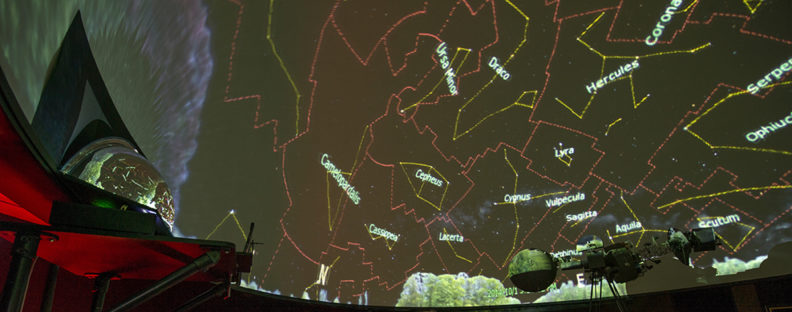
We are gratified that our series of informative and entertaining shows for the general public have proven popular. In 2014 with a 2016 upgrade, we installed a spheric-mirror digital projection system to enable a whole new layer of flexibility in the star theater, including the capability to show fulldome movies. Our dome was painted a friendly gray color in 2019 to reduce light echoes and improve contrast.
Funds from ticket sales maintain and improve our surround sound and full dome visual systems and guarantee an offering of even more spectacular public events in the future. The WSU Foundation will be happy to assist you if you wish to accelerate the upgrades with a financial gift (donate to “gf007726 – Planetarium and Observatory Support Fund”).
Our offerings:
- Day time school / children’s groups ($0), scheduled by gworthey@wsu.edu.
- Evening public shows ($5. We are pleased to begin offering advanced ticket sales via credit card. See individual show descriptions for links.)
- Corporate facility rental: scheduled by gworthey@wsu.edu.
Directions and parking
Directions from Stadium & Main: Turn up Stadium, immediate left at Nevada, immediate left at Washington, turn right on Spokane Street and go 2.5 blocks. Sloan Hall is on your left, but if you are parking, turn left or right on College Ave to seek parking.
For walkers coming from campus, the pedestrian bridge is the most convenient entry; come across the bridge, come in the building, then turn right. Twenty paces later, just past the staircase double doors, turn left and head down the hall to Sloan 231. There are placards pointing the way, but they are unobtrusive.
If you come in the main Sloan Hall entrance, the one with all the signage and lots of glass, you are a level below the pedestrian bridge and the planetarium. Take an immediate left, then enter the staircase with the double doors on your left. Go up one floor. The planetarium is down the hall.
- Parking near the planetarium is “Green 3” zone.
- Parking on weekends and after 5 p.m. is free.
- Buses: During business hours, parking for buses is free on Flag Lane.
- Cars: During business hours, use the AMP parking app for hourly parking, available from WSU Parking Services.
Now showing
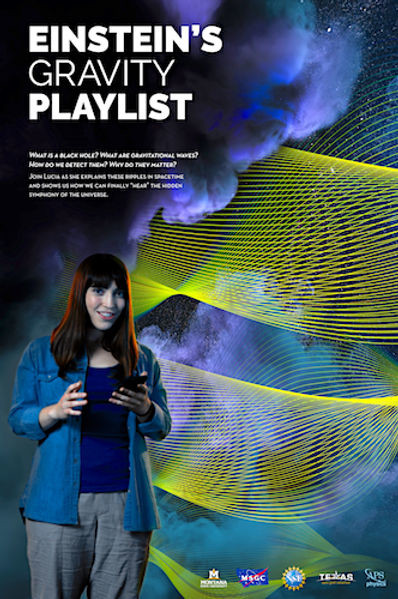
Einstein’s Gravity Playlist
7pm, Friday, Oct 16 and 5pm, Sunday, Oct 18.
A docent will point out night sky highlights and upcoming astronomical events. This is followed by a fulldome video presentation.
The short film Einstein’s Gravity Playlist was produced a stone’s throw away in Montana. Lucia, an astrophysics graduate student, explains Einstein’s theory of general relativity. This theory predicts the existence of black holes and furthermore predicts the possibility of gravitational waves; ripples in spacetime. The nearby gravitational wave observatory, LIGO/Hanford, has detected the “inspiral” of binary black holes.
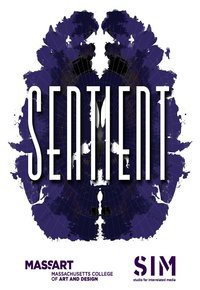
SENTIENT
7pm, Friday, Oct 23 and 5pm, Sunday, Oct 25.
A docent will point out night sky highlights and upcoming astronomical events. This is followed by a fulldome video presentation.
The short film SENTIENT examines the nature of consciousness. It blends psychedelic imagery with poetic narration and an electronic soundscape. It is, honestly, quite weird, and not at all what you’d expect at a planetarium.
Some of the imagery is strangely disturbing, so this film is not recommended for people who don’t like horror movies or people with trypophobia.

The Skies of Samhain
7pm, Friday, Oct 30 and 5pm, Sunday, Nov 1.
A docent will point out night sky highlights and upcoming astronomical events. This is followed by a narrated fulldome presentation (no video for this show).
Explore the historical origins of Halloween. They are partly astronomical, as Halloween falls midway between equinox and solstice, and they are partly cultural and religious, born in the ancient northwestern parts of modern day UK. “Samhain” is both the name of the ancient Gaelic holiday and the modern Gaelic name for the month of November.
Store the harvest and save the light against the long darkness to come.
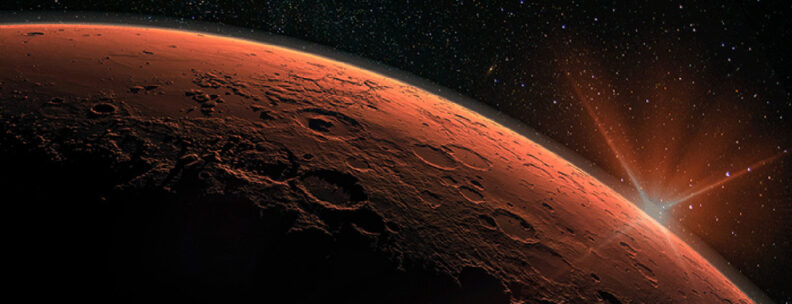
Mars: The Ultimate Voyage
7pm, Friday, Nov 6 and 5pm, Sunday, Nov 8.
A docent will point out night sky highlights and upcoming astronomical events. This is followed by a fulldome video presentation.
The Red Planet has captured our imagination throughout history, and never more so than today. Unlike hellish Venus, Mars has a 24 hour day, a familiar seasonal tilt, and lots of empty desert, like Sun City, AZ before it was a retirement community. True, it has no air and it’s almost never warm enough there to unfreeze water, but surely, we’re smart enough to solve a few problems along the path to colonization.
Cycle | The Incredible Sun
7pm, Friday, Nov 13 and 5pm, Sunday, Nov 15.
A docent will point out night sky highlights and upcoming astronomical events. This is followed by a fulldome video presentation.
It’s hard to tear your eyes away from timelapse photography. The pair of short films, Cycle and The Incredible Sun, use time compression to highlight nature’s wonder. Cycle began as a professor’s test of new wide-angle video equipment, and ended up as a visual celebration of earth’s rich environments. The Incredible Sun compresses satellite data that span wavelengths of light we can’t see in the far ultraviolet and X-rays bands to give us new perspectives on our cosmic powerhouse next door.
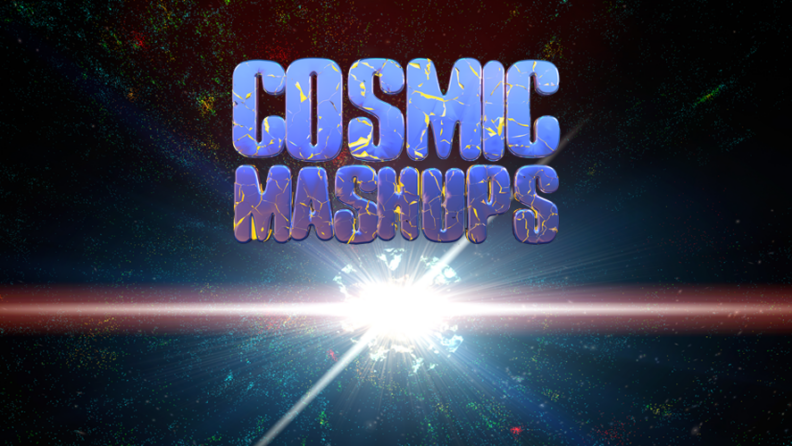
Cosmic Mashups
7pm, Friday, Dec 4 and 5pm, Sunday, Dec 6.
A docent will point out night sky highlights and upcoming astronomical events. This is followed by a fulldome video presentation.
What happens when galaxies collide? Come to the planetarium and find out.
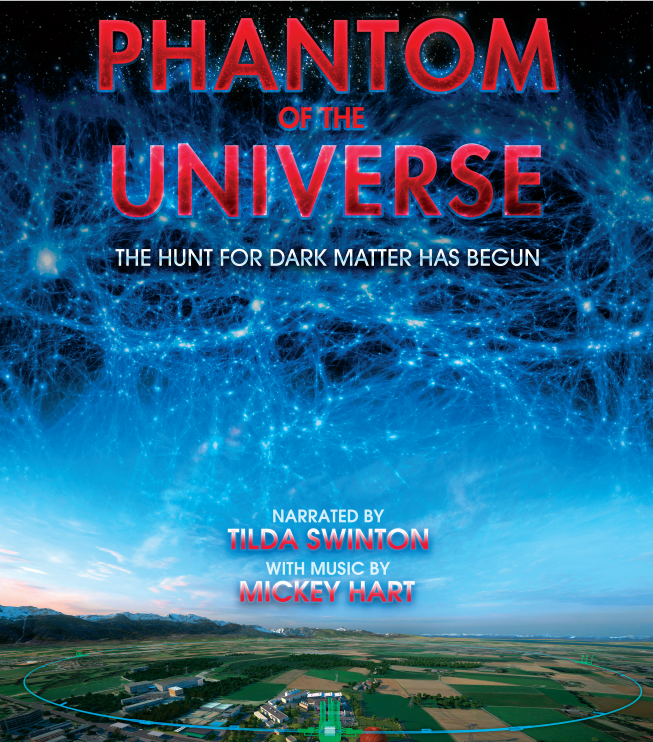
Phantom of the Universe
7pm, Friday, Dec 11 and 5pm, Sunday, Dec 13.
A docent will point out night sky highlights and upcoming astronomical events. This is followed by a fulldome video presentation.
It doesn’t seem quite fair that 4/5 of the universe goes unseen and undetected except via its gravitational pull. Tonight’s video recaps the background about dark matter, then describes current, bold experimental efforts to directly detect the stuff.