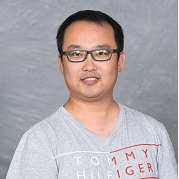
- Assistant Professor
Biography
Dr. Guan’s research centers on the theoretical investigation of quantum phenomena in both few- and many-particle systems. Recent advances in laser cooling and trapping techniques have facilitated the realization of ultracold quantum matter in a variety of platforms, including ultracold Bose gases, trapped ions, atomic arrays, and cold molecules. These systems, characterized by their high tunability and isolation from external perturbations, serve as ideal platforms for implementing various quantum technologies, such as quantum simulation, quantum sensing, and quantum computing. One research direction is to understand the collective behavior and non-equilibrium phenomena in these quantum systems.
Advancements in techniques like optical tweezers and single-atom imaging have enabled precise manipulation of cold atoms and molecules at the single-particle level. Theoretical studies of few-particle quantum systems offer critical insights that complement many-body theory, bridging the gap between microscopic interactions and macroscopic quantum behavior. These studies are also closely connected to fields such as nuclear physics and quantum chemistry.
Non-equilibrium phenomena in many-body quantum systems:
One system of particular interest in our research is the non-equilibrium Bose-Einstein condensate (BEC). Our research encompasses several topics, including the dynamics of cold atoms under synthetic gauge fields, such as synthetic spin-orbit coupling, the spin and spatial dynamics within spinor BECs, collisions between BECs, dynamics near quantum phase transitions, and phenomena related to quantum chaos. The primary objectives are to explore effects that go beyond mean-field theory, to harness quantum entanglement for enhanced quantum sensing, and to engineer processes related to thermalization and information scrambling in these systems. Understanding these phenomena is crucial for advancing both fundamental physics and practical applications in quantum technology.
Dynamics of few-body systems:
One example of a few-body system that we study is the small helium cluster, such as the helium dimer and trimer. These clusters can be driven out of equilibrium by an ultrafast laser pulse, allowing for the exploration of their quantum dynamics. Due to the relatively limited degrees of freedom in these systems compared to those with millions of particles, their dynamics can be simulated in continuous space fully quantum mechanically. Theoretical results for these systems often show excellent agreement with experimental data typically without any free parameters. Manipulating the dynamics of such few-body systems has broad applications, including the exploration of universal and non-universal physics in few-body quantum systems, the engineering of quantum reactions, and providing insights into the behavior of larger clusters. These studies contribute to a deeper understanding of fundamental quantum processes.
Education
- PhD Physics 2017, Washington State University
- BS Physics 2012, University of Science and Technology of China
Research Interests
- Quantum phenomena in few- and many-particle systems
Selected Publications
Google scholar (link)
- Quench-induced nonequilibrium dynamics of spinor gases in a moving lattice. Z. N. Hardesty-Shaw. Q. Guan, J. O. Austin, D. Blume, R. J. Lewis-Swan, and Y. Liu, , Phys. Rev. A 107, 053311 (2023)
- Tailored generation of quantum states in an entangled spinor interferometer to overcome detection noise. Q. Guan, G. W. Biedermann, A. Schwettmann, and R. J. Lewis-Swan, Phys. Rev. A 104, 042415 (2021)
- Identifying and harnessing dynamical phase transitions for quantum-enhanced sensing. Q. Guan and R. J. Lewis-Swan, , Phys. Rev. Research 3, 033199 (2021)