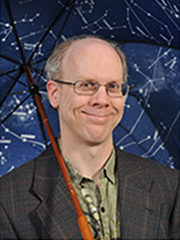
- Professor, Career track
Biography
Research Interests
Michael Allen is an observational astronomer. He is a member of two robotic telescope networks: Skynet, and Las Cumbres Observatory. His research is three-pronged. (1) He observes variable stars in the visible and infrared to test the relationship between period, luminosity, and heavy element content. (2) He writes and tests curriculum related to robotic telescopes, student content knowledge, and student self-efficacy in STEM disciplines. (3) He is broadly interested in the connection between supernova explosions and the interstellar medium with respect to the production of high energy cosmic rays.
Visit the Astro-imaging website.
(This link leads to a WSU faculty-maintained lab or research group website. The views and content expressed are those of the faculty member or group and do not represent the official positions or policies of the university.)
Education
- PhD Astronomy 1999, University of Toronto
- MS Astronomy 1993, University of Toronto
- BS Physics 1992, McMaster University
Awards & Recognition
- 2025 Nancy Liu Yang Award for Excellence in Teaching International Students, International Programs, WSU
- 2022 Excellence in Assessment, Office of the Provost, WSU
- 2022 Excellence in Advising Award, College of Arts & Sciences, WSU
- 2016 Excellence in Teaching Award, College of Arts & Sciences, WSU
- 2013 Distinguished Lecturer, Honors Student Advisory Council, WSU
- 2011 Excellence in Advising Award, College of Sciences, WSU
Selected Publications
Google scholar (link to Google Scholar profile)
Links open in this window.
** Publications marked with asterisks have undergraduate student authors.
- Finding the distance to the RRLyrae star CF Leo, C Mayo, and ML Allen. JAAVSO, v53, 2025. (link to Finding the distance to the RRLyrae star CF Leo) **(has undergraduate student authors)
- Distance to AA Leo using ground-based photometry and period-luminosity-metallicity relation. J Lewis, and ML Allen. JAAVSO, v53, 2025. (link to Distance to AA Leo using ground-based photometry and period-luminosity-metallicity relation.) **(has undergraduate student authors)
- The Multiwavelength Universe. J Keohane et al. (ML Allen). Open education resource. (link to The Multiwavelength Universe)
- The Moon. What is it made of? Where did it come from? ML Allen. National Center for Case Study Teaching in Science. NSTA. (link to The Moon. What is it made of? Where did it come from?)
- Farming in Space. Developing a Sustainable Food Supply on Mars. HS Joiner, and ML Allen. National Center for Case Study Teaching in Science. NSTA. (link to Farming in Space. Developing a Sustainable Food Supply on Mars.)